

For restaurants, bars and hospitality venues that want more flexible guest communication inside the venue, searching for digital signage for restaurants is rarely about finding a supplier with the longest service list. The real question is whether the work can help the business turn screens into useful menu, promotional and event communication tools while keeping the guest experience on-brand. Hospitality decisions happen across several touchpoints, so strategy has to fit the way guests actually discover, compare and choose a venue.
A common gap appears when marketing is split between separate freelancers, disconnected campaigns and tools that do not share the same brand or objective. That can produce plenty of activity without a clear path from attention to a booking, visit or sale. Goldroom positions its model around connected branding, digital marketing, content and in-venue media for hospitality and local brands.
Related searches such as restaurant digital signage, digital menu boards restaurant and restaurant screen advertising often signal different stages of the same decision. This article uses them where they add context rather than repeating them mechanically.
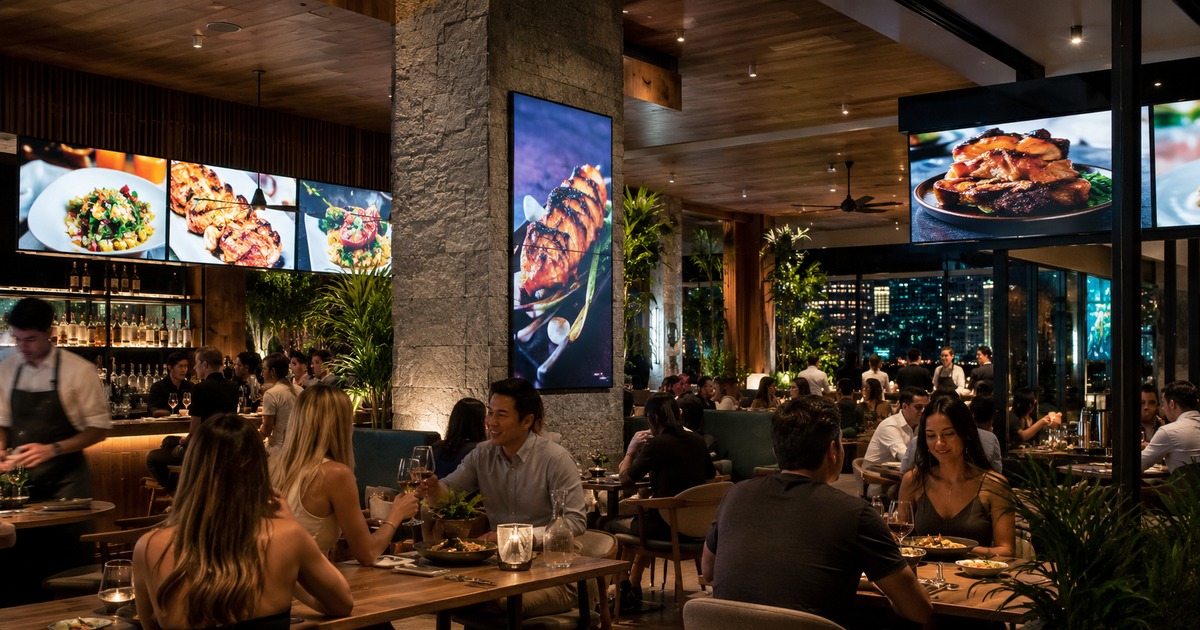
Build for the Next Stage, Not Just Launch Day
The strongest starting point is a clear commercial outcome. Here, that means turn screens into useful menu, promotional and event communication tools while keeping the guest experience on-brand. Once that is defined, the supporting work can be mapped across menu and special boards, happy-hour and event promotion and sponsor and partner content. This keeps the discussion grounded in the customer experience rather than turning the article into a list of agency deliverables.
Hospitality also creates a practical constraint: marketing has to work while the venue is operating. Teams are serving customers, menus and events change, and managers cannot spend every day rebuilding campaigns. A useful system therefore needs repeatable templates, clear approval paths and enough flexibility to respond to operational change.
Measurement should follow the same logic. Useful signals include promotion awareness, offer uptake, event attendance, content update speed and reduced print material. Those metrics sit closer to commercial performance than surface-level activity alone and help a venue decide what should be continued, changed or stopped.
What a Strong System Should Include
Menu and special boards
Menu and special boards should be defined so staff and partners can apply it consistently. For restaurants, bars and hospitality venues that want more flexible guest communication inside the venue, this matters because expectations are formed before arrival and then tested again inside the venue.
Happy-hour and event promotion
Happy-hour and event promotion needs to connect with the next customer action rather than exist as a standalone task. A useful implementation makes the transition from discovery to consideration to booking or purchase feel obvious.
Sponsor and partner content
Sponsor and partner content becomes more valuable when it can be updated without rebuilding the whole campaign. Hospitality teams need systems that can handle seasonal changes, events and day-to-day operational reality.
Welcome and wayfinding messages
Welcome and wayfinding messages should be reviewed against both brand consistency and commercial performance. If it looks polished but creates friction for customers or staff, it needs refinement.
Two further considerations are daypart scheduling and central control across screens or locations. Together, these elements prevent the work from becoming a one-off campaign that loses relevance after launch.
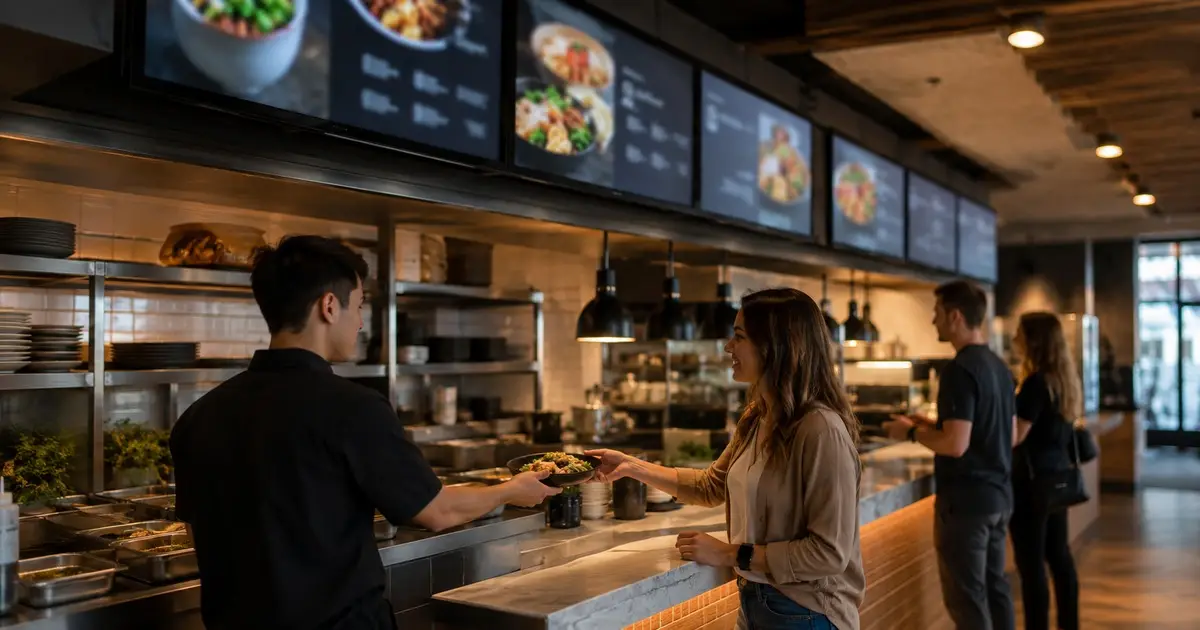
Local Search and Market Context
Restaurant signage works when it supports a guest decision at the right moment—before ordering, while waiting, during an event or when considering an additional offer.
Local SEO is stronger when a page demonstrates genuine relevance: accurate business information, clear services, useful location context, strong internal linking, mobile usability and content that answers the questions people in that market actually ask. Repeating a city name is not a substitute for those signals.
Implementation Details That Matter in a Real Venue
Screen technology is only useful when the physical environment and content workflow are considered together. Viewing distance, glare, mounting height, screen orientation, dwell time and the speed at which customers move through the space all affect what people can actually read.
Content management matters just as much. Menus and promotions need a clear owner, an approval process and a scheduling method. Multi-location operators also need rules for what is controlled centrally and what each location may change. This is where digital signage becomes an operating system rather than a collection of screens.
Goldroom Media is positioned around digital menu boards, in-venue promotions, event and sponsor content, multi-location management and audio branding. For hospitality, that combination connects screen communication with brand, trading rhythm and guest experience.
Common Mistakes to Avoid
Most marketing waste does not come from doing nothing. It comes from reasonable-looking activity without a connected strategy or a clear definition of success.
- Avoid: placing screens where guests cannot see them.
- Avoid: running unrelated advertising.
- Avoid: using outdated event slides.
- Avoid: overloading screens with messages.
- Avoid: ignoring lighting and viewing distance.
The practical fix is to map the customer journey, agree on the commercial outcome and decide who owns each step before adding more channels or creative.
Practical Checklist Before You Start
- Define the primary outcome: turn screens into useful menu, promotional and event communication tools while keeping the guest experience on-brand.
- Audit the current position for menu and special boards and happy-hour and event promotion.
- Decide how sponsor and partner content connects with the rest of the customer journey.
- Confirm who owns content, approvals, account access and day-to-day updates.
- Choose commercial measures such as promotion awareness, offer uptake, event attendance.
- Check that location, opening-hour, menu, booking and contact information is accurate where relevant.
- Plan how successful creative can be reused across search, social, ads and in-venue media.
- Review performance on a set cadence and document the next change.
How Goldroom Fits the Hospitality Use Case
Goldroom describes itself as a hospitality-focused digital agency that connects brand strategy, creative, digital marketing and in-venue media instead of treating each channel as a separate project. Its public service pages focus on cafés, restaurants, pubs, bars, hotels, live venues, local businesses and multi-venue groups.
For this topic, the most relevant starting points are Goldroom Media, Goldroom Venues, Branding and Contact Goldroom. These internal links create a clear path from the educational article to service pages that explain how the work is approached in practice.
Goldroom’s published process moves from discovery through design or planning, deployment or launch, and optimisation. That matters because hospitality marketing is not finished when an asset goes live; menus, campaigns, screens, search demand and customer behaviour all change.
Frequently Asked Questions
What should a business compare when choosing help for digital signage for restaurants?
Start with the business outcome, relevant hospitality experience, the process for strategy and execution, how performance will be measured, and whether the work connects with existing brand and venue operations. Pay particular attention to menu and special boards, happy-hour and event promotion and sponsor and partner content.
How long should it take to see useful results?
It depends on the channel. Paid media can generate data quickly, while SEO, brand recognition and repeat-customer effects usually build over a longer period. Separate leading indicators from commercial outcomes that need more time.
Should hospitality businesses manage everything in-house?
Not necessarily. Some venues keep day-to-day updates and customer interaction in-house while using a specialist partner for strategy, creative systems, media buying, SEO, branding or digital signage. The right split depends on skills, time, approval speed and the number of locations.
What should be measured?
Use measures related to the job being done. Useful examples here include promotion awareness, offer uptake, event attendance and content update speed. Avoid treating one metric as proof of success when the customer journey involves several channels.
What to Prepare Before Working With a Specialist
Before briefing a partner for digital signage for restaurants, collect information that explains how the business actually trades. Include priority services or menu categories, busy and quiet periods, customer types, geographic catchment, current channels, booking or enquiry routes, upcoming events and the constraints staff face during service. Better input produces a more useful strategy because the partner can design around reality rather than assumptions.
Give the partner access to evidence where available: website analytics, advertising history, search data, booking information, social performance and examples of previous campaigns. The goal is not to preserve every old tactic; it is to understand what has already been tested, where the customer journey breaks down and which assets can be reused.
Agree on responsibilities early. Clarify who approves creative, who updates menus or offers, who owns advertising accounts, who responds to customer messages and how urgent changes are handled. This operational layer often determines whether a good strategy can be executed consistently.
Set a review rhythm that matches the work. Some indicators can be monitored frequently, while brand consistency or organic search visibility should be reviewed over a longer window. Keep the discussion connected to promotion awareness, offer uptake and event attendance rather than changing direction because of one isolated number.
Final Takeaway
A strong approach to digital signage for restaurants starts with a clear commercial outcome and a realistic understanding of how hospitality customers move between search, social media, advertising, branding and the physical venue. The best system is not the one with the most activity; it is the one that makes the customer journey clearer and gives the business enough data to improve.
If you are evaluating support in this area, review Goldroom’s relevant service, explore the broader Goldroom services, and use the contact page to discuss the venue, audience and commercial goal before deciding on scope.